
History & Memory: Ethical Dimensions

Eighty years after World War II, the second edition of the Passau Summer School for Applied Ethics was dedicated to the theme of responsible engagement with historical memory.
In three international and interdisciplinary working groups, students discussed profound ethical questions such as: Is engaging with history a moral duty? What are the duties of anamnestic justice, and what do they entail? How can we do justice to historical injustice?
Each working group followed their own path of inquiry. While the group “Digitalization” reflected on the role digital technologies play in shaping our engagement with history, the group “Future of Europe” dedicated itself to the question of how Europe should remember. The third group, “Sustainability,” focused on the question of whether and how we should remember nature.
To share their insights beyond the classroom, the students wrote texts, produced soundscapes, podcasts, and videos, and added visual elements such as infographics and photographs. Together they created the following Scrolly Telling, which invites you to interactively explore the ethical dimensions of history and memory.
Memory & Digitalization
What can or should we remember digitally?
Memory shapes how we understand our history and navigate the present. Remembering, however, is never neutral and involves choices about which events we highlight, which stories we tell and which we omit. In this sense, as Alexandre Dessingue mentioned in The Ethics of Memory in My Heart of Darkness, memory is not to be considered as a primary act of remembrance, but as something shaped by the remediation of past events through narrative evolution. In their contribution to Stanford Encyclopedia of Philosophy Kourken Michaelian and John Sutton point out that this lack of neutrality is the core interest point of ethics of memory. It is a field which examines the moral dimensions of memory and the process of remembering. The central questions of this field are, for example, who has the authority to determine what is remembered or forgotten? Which, if any, moral obligations do societies have towards victims of
historical injustice? How do memorial practices influence reconciliation or deepen divisions? How does the increasingly digital world affect the most personal aspects of our life, such as the process of grieving after a loss of a loved one? By attempting to answer these questions we can better understand our roles as ethical actors within broader historical and contemporary communities. The following text will firstly explore the concepts of the duty to remember and the right to be forgotten and then explain what it means to remember ethically in times of digitalization.
In traditional societies, remembering was part of oral traditions, rituals, historical narratives and religious practices. Because humans can only remember a certain amount of data, these forms of memory were selective and interpretive. With the increasing presence of digital technologies in our daily lives, memory has seemingly become permanent. Digital platforms promise inclusivity and democratization of memory and to permanently preserve vast amounts of information.

These promises can raise ethical questions. What happens when every moment, trauma or mistake remains permanently recorded online? Unlike traditional memory practices which naturally fade over time, digital memory can create perpetual visibility, eliminating the possibility of forgetting and moving forward. Furthermore, digital memory is especially vulnerable to manipulation and distortion. Search engines such as Google can pull data out of context and/or selectively interpret it. Due to these mentioned dangers, it is important to examine the ethical implications of digital remembrance.
The internet never forgets. This has given rise to demands for a “right to be forgotten“; that represents a legal and ethical doctrine which permits individuals to petition for the erasure of personal information that is no longer relevant or that inflicts unjust injury on their dignity. Codified in the European Union´s General Data Protection Regulation (GDPR), this right contradicts the notion of complete and eternal memory. It holds that individuals need to have authority over their digital selves and that forgetting is equally vital to personal agency as remembering is to collective identity. As Lutz Peschke mentioned in his work The Web Never Forgets! Aspects of the Right to Be Forgotten, this challenges the assumption that remembering is the norm and forgetting the exception, an assumption now being renegotiated in the digital age.
The tension between the responsibility to remember and the right to be forgotten is even more acute when we apply it to cases where public interest and private rights intersect. For instance, should a public figure be able to erase past criminal records from search engines if they have been rehabilitated? Should digital platforms preserve the content of controversial tweets or blog posts even when their authors regret them? Should historical documents containing offensive language be censored or removed to prevent harm, or preserved as part of historical truth?
In considering what should be remembered digitally, we must therefore navigate a complex ethical landscape. On the one hand, we must protect the integrity of historical memory, especially when it involves marginalized voices and traumatic experiences. The digital sphere offers unprecedented opportunities to include perspectives that were historically silenced: women, LGBTQ+ communities, ethnic minorities and victims of colonialism or war. Digital storytelling, oral history projects or online exhibitions have the potential to democratize memory and make it accessible to a worldwide audience. We must also take into account that digital memory is not indifferent towards their users. Digital infrastructures can be owned by private corporations with their own economic and political agendas. This could result in algorithms prioritizing certain narratives over others that are not necessarily better for users. The permanence of digital traces could also lead to surveillance, shaming as well as erosion of privacy. This is why remembering digitally should be accompanied by transparency and consent. Moreover, digital memory raises concerns of intergenerational ethics. The digital legacy that we will transmit to future generations could determine whether they will be confronted with a fragmented and decontextualized flood of information or encounter narratives that will promote empathy, historical responsibility, and critical understanding. It should call for equivalence between spreading knowledge while protecting human dignity. To engage with it ethically, we must understand memory as something lived and interpreted as an expression of identity. Developing a digital ethics of memory represents being aware of the tensions between remembering and forgetting, and seeking approaches that honor the past, respond thoughtfully to the present, and remain accountable to the future.
Do We Have a Duty to Remember or the Right to Be Forgotten?
“Remembering may change, but never be lost”
(Universität Koblenz, n.d., freely translated by the author)
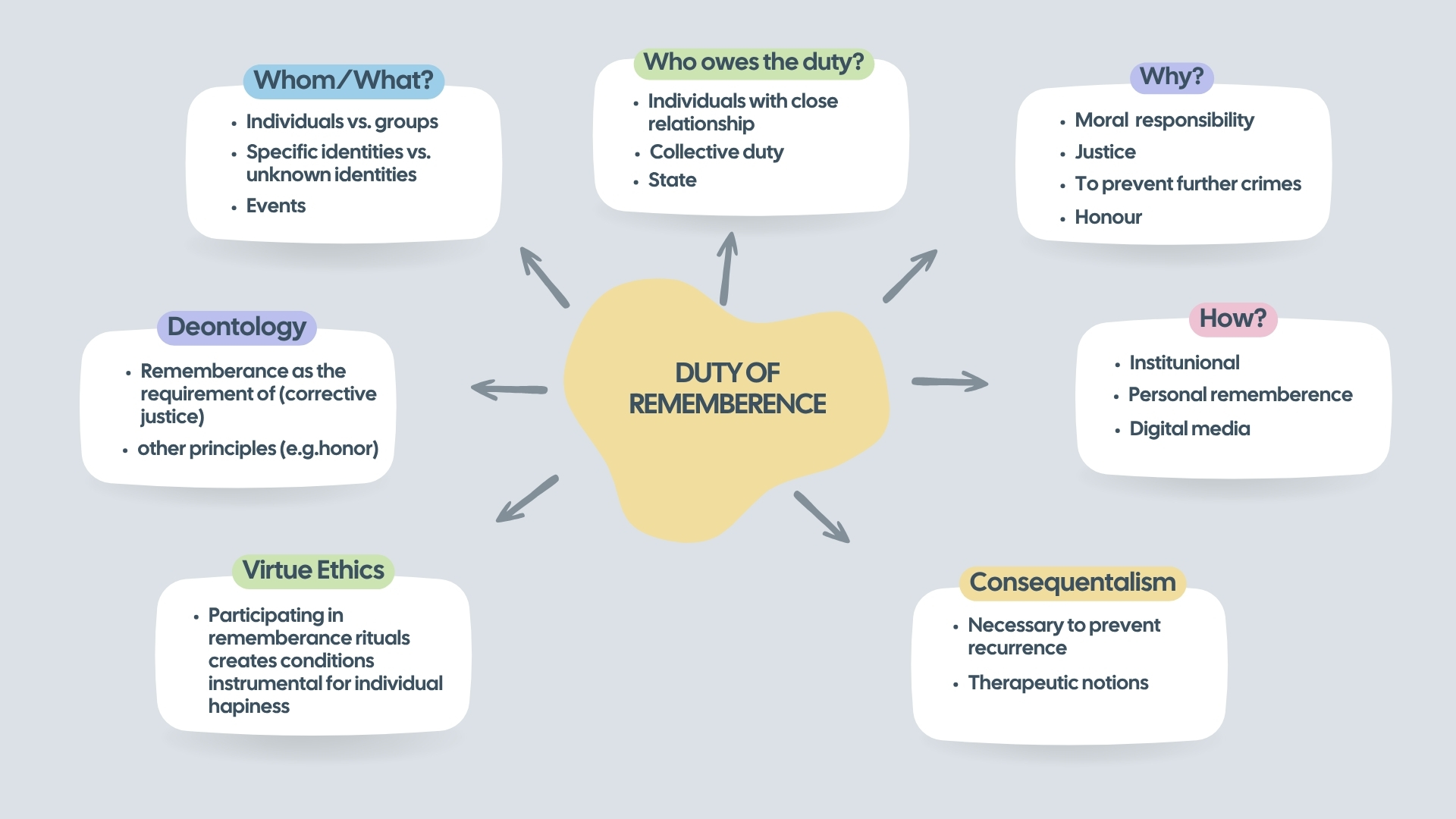
In A Duty to Remember Jeffrey Blustein claims that we have a moral duty to remember, especially when it comes to atrocities and collective traumas. But in a digital age, where our past is always present, some argue for a right to be forgotten, a right to move on. These two perspectives challenge us to think about the ethics of memory in new ways. Must we always remember, or can forgetting sometimes be justified? Another question arises:
Do we have a duty to remember?
Blustein explores in his text the idea that remembering certain past events, especially atrocities, is not just a cultural habit but a moral obligation. There is a duty to remember the victims of injustice and atrocity and to acknowledge the suffering of victims who resisted these crimes and took personal risks to rescue the ones who were in harm’s way.
Bluestein differentiates between duties to remember specific individuals, like victims,
rescuers or absent friends and duties concerning anonymous or collective subjects, like entire communities . He also notes that „a duty to remember may refer primarily to events rather than to people“, where the moral significance lies in their broader human impact. This suggests that obligations for remembering extend beyond personal ties and require societies to confront themselves with historical events, such as genocides, slavery or colonialism. Facing this remembering becomes a part of collective ethical responsibility.
In the end meaningful remembrance requires a combination of different agents, individuals
who engage personally, institutions that provide places for remembrance like museums and archives and collectives that preserve shared memory.
Does forgetting mean erasing or something more?
In human memory, forgetting is a natural and often necessary process – it allows individuals
to move on from their past and develop over time. In contrast, digital memory is characterized by permanence: computers are designed to store information indefinitely. While forgetting is sometimes seen negatively, it can be essential for personal growth and renewal. Being permanently confronted with one`s past – especially in an online context, can hinder change, self-reinvention, and social reintegration, as Kourken Michaelian and John Sutton point out in the Stanford Encyclopedia of Philosophy.
In The Right to Be Forgotten and Informational Autonomy in the Digital Environment Cécile De Terwangne explains that the right to be forgotten has emerged as a legal and ethical response to this digital permanence. It does not necessarily imply that information is entirely erased, but rather that it is no longer easily accessible or continually resurfacing in contexts unrelated to its original purpose. In this sense, the right to be forgotten protects individuals from the decontextualized and disproportionate exposure of past actions, especially when those actions are no longer relevant.
The right to be forgotten is closely linked to the concept of informational autonomy, the ability of individuals to control their personal data and how it is used. In the digital age, informational autonomy becomes an essential aspect of individual freedom, as people
increasingly live their lives online. Without mechanisms like the right to be forgotten,
individuals risk being defined by past digital traces beyond their control.
What is the right balance?
The role of names holds central importance in both concepts. Once a name is given, an
emotional connection is immediately established. A well-known example is Anne Frank. Through her, the persecution of the Jews becomes more personal. She has her own story.
Identifying victims by their names serves to honor their dignity and restore their individuality. On
the other hand, in the case of collective crimes, it is not always possible to remember all the names or to learn the history of each individual, so we sometimes think of the victims only as a whole. This raises the question of tangibility. We also do not know if the victims wanted to be remembered, and if so, how. For example, at Hartheim Castle (one of six killing institutions of National Socialist euthanasia), there is a glass memorial plaque with the names of people murdered there. It is also noted that some victims’ names are not listed due to the absence of consent from their relatives. Hartheim Castle indicates this on the glass memorial and includes empty spaces to acknowledge unlisted victims.
Conversely, identifying perpetrators transforms faceless crimes into recognizable acts committed by identifiable actors. Furthermore, the use of names reflects historical truth, as Blustein stresses in A Duty to Remember. However, the remembrance of perpetrators by name can trigger victims. For instance, there are still monuments and statues around the world to people who abetted or took part in the murder of Jews and other minorities during the Holocaust. To find concrete example visit: https://shorturl.at/jDpiL
On the other hand, Terwangne argues that people’s identities should generally be protected through anonymity when something is no longer newsworthy. The exception is built on the remaining historical or public interest. Another factor is rehabilitation. For instance, if a person has served their sentence and remained out of trouble for years, anonymization is increasingly warranted. Above all, removing names can help lift the stigma and reduce the harm the person may otherwise experience, as she explains.
Digital information possesses near-permanent characteristics. Historical articles, social media posts, and legal documents maintain high accessibility, while search engines aggregate dispersed content fragments and resurface them for public view. Personal information becomes often decontextualized from its original circumstances. In addition, it appears current, despite originating from much earlier time periods.
Considering this, informational autonomy is essential, as De Terwangne states. Tools that can help maintain informational autonomy include, for example, de-indexing, anonymization, restricted access, and context notes. It is also important to consider that these protections can conflict with other important values such as freedom of the press, complete public archives,
historical research, and society´s duty to remember victims and learn from wrongdoing , as she underlines.
It is therefore important to bear in mind that the right to be forgotten applies only to digital media.
There is no possibility to erase non-digitized forms of remembrance.
Furthermore, the capitalism part of the right to be forgotten can be discussed. According to De Terwangne the storage of the data became less expensive than destroying and anonymizing it. Is this ethically correct?
Overall, De Terwangne argues for careful balancing rather than automatic deletion or disclosure. Furthermore, the right to be forgotten is not about erasing history, but about restoring a fair balance between memory and forgetting, enabling people to reclaim agency over their digital identities and futures.
How Can We Remember Ethically in Times of Digitalization?
From this falls the question how we can remember ethically in times of digitalization. As a student sometimes philosophical questions can seem difficult to answer and can be overwhelming. To help you to develop your own way of thinking this article introduces a step-by-step guide on how to answer general ethical questions like ‘how can we remember ethically in times of digitalization’?
1. What is ethical remembrance?
The first step to answer the question is to understand the general definitions behind the key words of the question. So, what is remembrance in the first place? And what do we mean by ethical remembrance in the second step? The action of remembering can be defined as interacting with ‘something’ of the past. ‘Something’ could be replaced with certain events, people, or other things that are important for us as human beings. Next, we can introduce the concept of ethical remembrance. If we have difficulties thinking about examples, it might help to think about the contrary. So, what could be an example for unethical remembrance? In general, unethical remembrance could be, for instance, ignoring the past in general, or different perspectives about past events, as well as replicating dominant narratives blindly. Now we could think about actions which we could take to remember the mentioned in an ethical way. Ethical remembrance could be a critical way of thinking about the past, balancing different positions, and diverse perspectives regarding past events.
2. What is digital remembrance?
Before thinking about ethical remembrance in the digital world, an intermediate step could be to think about digital places, where we can find digital remembrance and by whom these places can be used. We could think about individual’s postings about daily life, the press posting about historical events, collectives speaking up about their perspective on certain topics, or the state informing the public. Lastly, we could also think about where these are captured, i.e., social media, online magazines, or governmental sites. Finally, we could summarize the actions to answer the question as follows: Digital remembrance is capturing important things of the past in the digital world.
3. What does it mean to remember ethically in times of digitalization?
In the last step we try to think about the concepts of (un-)ethical remembrance and digital remembrance together. In times of digitalization, we are confronted with an algorithm-based inhibition of critical thinking and pipelines that close off the user from deferring perspectives in history (echochambers). As this problem is arising by the use of technology, we could say that ethical remembrance in times of digitalization is the implementation of actions like critical thinking, and balancing diverse perspectives by the human being.
4. Practical examples of (un-)ethical remembrance in times of digitalization
4.a. The “coolification” of fascism as example of unethical digital remembrance
A phenomenon which we can characterize as an example of unethical digital remembrance could be “coolification” of fascism. Online echochambers are ever-present on social media, especially after the rise of algorithm-based media such as TikTok, Instagram reels or YouTube shorts. Included are some examples which use “dogwhistles” with an aim to bypass regulations against hate speech and misinformation. According to Marloes Geboers and Marcus Bösch in the article Malicious earworms and useful memes, hate groups tend to communicate with each other online without appearing hateful, using code words, symbols, or audio trends. Under the guise of history, they often present the past in a highly fictional, one-sided and uncritical way. → The term “dogwhistles” denotes a coded language. Its nature is notoriously fluid, polysemous, and subject to change, which makes it hard to moderate. This keeps hate-speech continuing even on websites where it is prohibited.
4.b. Holocaust projects as an example of ethical digital remembrance
An example of ethical digital remembrance is a project of the Museum of Jewish Heritage in New York. It uses technology to provide the user with the possibility to interact with a hologram of a holocaust victim – online or on sight. The interested party can ask questions and the hologram replies with an answer from a pre-recorded and scientifically moderated interview.
https://mjhnyc.org/exhibitions/survivor-stories/
Another example of an ethical remembrance project which operates on a democratic, but multi-perspective and critical basis is the Yellow star houses project. Their website captures the historical context of ghettoization of Jews in Budapest, pinpoints the “yellow star houses” on a map, combines it with modern pictures of the buildings and with oral testimonies of people who used to live in them.
https://www.yellowstarhouses.org/#
Conclusion
Throughout our inquiry, we have seen that memory is an everchanging interpretative process that is developed and continually reconstructed based on the dominant discourses in any given society. We exposed the fact that the ethics of memory supposes that remembering involves contingent moral choices, fiats of the will, regardless of whether such memory is individual or collective. The link between memory and power apparent when we start to ask who decides what ought to be remembered or forgotten and how such decision(making) impacts individuals and societies. While the material tools of mechanical reproduction of memory advance as we enter the age of digitalization (internet, social media, data-driven algorithms, etc.), the above-mentioned question remains the same. Although new digital technologies offer new possibilities for inclusion and preservation, by virtue of doing so, they pose an obstacle to the natural process of forgetting (delaying or hindering it completely), introduce risks of distortion, and raises concerns over surveillance and security (especially concerning the control over one’s digital identity). We cannot presume that the given ethical system we employ to address these risks is one that is free from internal contradictions; especially since we have seen how the normative concepts we used constantly enter into relations of mutual exclusion. There is perhaps no better example of this than the tension between the duty to remember (particularly when it comes to marginalized histories) and the right to be forgotten. Whatever digital ethics of memory we may subscribe to, it ought to be one that can sufficiently reflect the need for multiperspective history on one side and protect personal agency and dignity on the other. Identifying perpetrators of crimes is necessary to satiate public interest, yes, it is perhaps even a conceptual aspect of accountability.
And yet, despite this, such identification can also retraumatize victims, and – provided that a certain time has passed – hinder the rehabilitation of the perpetrator. Within the span of human life, the imperative to protect individual agency grows over time as public interest fades and rehabilitation has occurred. Under such circumstances, methods such as data anonymization and deindexing can contribute to harm reduction. The harm we identified stems from the fact that digital memory, unlike human memory, stores information indefinitely and often in a decontextualized way. By the virtue of this fact, information resurfaces and thereby hinders the possible reintegration of criminals who have served their sentences or, more generally, wrongdoers who repented for their wrongdoing. We have shown the concept of informational autonomy (how one’s personal data is remembered and forgotten) to be indispensable. The proportionalist balancing act of the law must weigh against each other these diverging interests as they change and clash in digital spaces. Whatever is the stance on the separation of law and morals in any given school of thought, the different philosophies of law broadly agree that morals ought to inspire the lawmaker: what then becomes the question to which all the hitherto discussion can be reduced is: HOW CAN WE REMEMBER ETHICALLY IN TIMES OF DIGITALIZATION? This is an open-ended question. As the guide above shows, we can learn plenty from identifying ethically questionable if not outright despicable practices (pipelines into fascist echochambers promoted by dogwhistle and coolifications, fictionalization and romanticizing of national history, glorification of a mythical past, tendentious interpretation and denialism, etc.) and negating them to discover their converse. We have presented a plentitude of such ethical practices: What they all have in common is that the critical approach of human beings is not supplanted by simplified and tendentious narratives inhibiting human engagement (be they authored by fascists or by data-driven algorithms). Instead, they are human through and through, always subversive, self-superseding and ruthlessly critiquing all that is.
Memory & The Future of Europe
How Should Europe Remember?
Why Look to the past when we want to shape the future?
“Only those who know the past can understand the present and shape the future.”, the German journalist and politician August Bebel is often quoted. And this carries a significant promise: it is that humans are able to learn from each other and from past experiences, which is a core idea of philosophical anthropology that characterizes humans, particularly expressed in Kant’s Anthropology from a Pragmatic Point of View. It is the rational ability of connecting our own thoughts to our future and challenges we might face. Through this crucial element of the human being – to abstract lessons from concrete events – it draws an important line from the past, which is accessible from a current perspective, to the present as we are only able to act and therefore live in the present. Not only that we can abstract from the past, but we can also use this knowledge to locate mistakes in coping with past events, in the sense of Bebel. And exactly that is what makes the past valuable for the future. In this constant process of learning, we are taught lessons that prepare us for future challenges.
Democratic values are rooted in their history
Democracies have changed over times as well, maybe were battered by totalitarian regimes once in their lifetime but nevertheless have overcome these phases. To preserve democratic values, society and its status it is essential to remember shared values, institutions and procedures as Margalit claims in Ethics of Memory. Democracy and the benefits it brings are built upon our constant effort to save our shared constitution and collective values, which enable our present lives to be fostered and further developed. We need knowledge of the past to shape the future of our democracies, as we rely on the lessons learned from where our institutions once lacked the means to overcome temporary crises, and because we continue to share values rooted in the past that evolve and consolidate over time. Democratic societies may be more complex to handle, but that does not outweigh the benefit it grants for every individual. To handle these complexities, we can have a look at the origins of democratic societies, their values and the opponents they faced, to look after our own democracies with attention to its procedures, strengths and weaknesses.
The Future of Europe as a Lesson of History
Europe as an environment of respect for Human Rights and commitment to democracy has faced various challenges and difficulties. In Europe we seem to consider “democracy” as a value as such, as it enables people to freedom and a flourishing society. Despite its legitimization by the demos, the nation’s population who engages in public policy, it is also in need of memory and knowledge about its own history. That derives from lessons we were taught in the past to maintain the current status we are living in. In times where we face a serious threat to values as democratic societies usually have such as a commitment to Human Rights, the Rule of Law and a collective-ethical process, it is even more important to learn from previous challenges our nations faced. It makes sense to describe it as an ethical call to position oneself clearly towards mistakes – such as economic exploitation, totalitarian deprivation of freedom or humanitarian catastrophes – never to be made again as a crucial lesson of Europe’s history. To protect our society and its values from these threats, we must engage in history to be equipped with wisdom to solve future problems.

Why Look to the Past When We Want to Shape the Future?
How the History of Europe becomes its Future. Or Not?
“Only those who know the past can understand the present and shape the future.”, the German journalist and politician August Bebel is often quoted. And this carries a significant promise: it is that humans are able to learn from each other and from past experiences, which is a core idea of philosophical anthropology that characterizes humans, particularly expressed in Kant’s Anthropology from a Pragmatic Point of View. It is the rational ability of connecting our own thoughts to our future and challenges we might face. Through this crucial element of the human being – to abstract lessons from concrete events – it draws an important line from the past, which is accessible from a current perspective, to the present as we are only able to act and therefore live in the present. Not only that we can abstract from the past, but we can also use this knowledge to locate mistakes in coping with past events, in the sense of Bebel. And exactly that is what makes the past valuable for the future. In this constant process of learning, we are taught lessons that prepare us for future challenges.
Democratic values are rooted in their history
Democracies have changed over times as well, maybe were battered by totalitarian regimes once in their lifetime but nevertheless have overcome these phases. To preserve democratic values, society and its status it is essential to remember shared values, institutions and procedures as Margalit claims in Ethics of Memory. Democracy and the benefits it brings are built upon our constant effort to save our shared constitution and collective values, which enable our present lives to be fostered and further developed. We need knowledge of the past to shape the future of our democracies, as we rely on the lessons learned from where our institutions once lacked the means to overcome temporary crises, and because we continue to share values rooted in the past that evolve and consolidate over time. Democratic societies may be more complex to handle, but that does not outweigh the benefit it grants for every individual. To handle these complexities, we can have a look at the origins of democratic societies, their values and the opponents they faced, to look after our own democracies with attention to its procedures, strengths and weaknesses.
The Future of Europe as a Lesson of History
Europe as an environment of respect for Human Rights and commitment to democracy has faced various challenges and difficulties to build these values. In Europe we seem to consider “democracy” as a value as such, as it enables people to freedom and a flourishing society. Despite its legitimization by the demos, the nation’s population who engages in public policy, it is also in need of memory and knowledge about its own history. That derives from lessons we were taught in the past to maintain the current status we are living in. In times where we face a serious threat to values as democratic societies usually have such as a commitment to Human Rights, the Rule of Law and a collective-ethical process, it is even more important to learn from previous challenges our nations faced. It makes sense to describe it as an ethical call to position oneself clearly towards mistakes – such as economic exploitation, totalitarian deprivation of freedom or humanitarian catastrophes – never to be made again as a crucial lesson of Europe’s history. To protect our society and its values from these discomforts, we must engage in history to be equipped with wisdom to solve future problems.
How Should We Understand "Europe"?
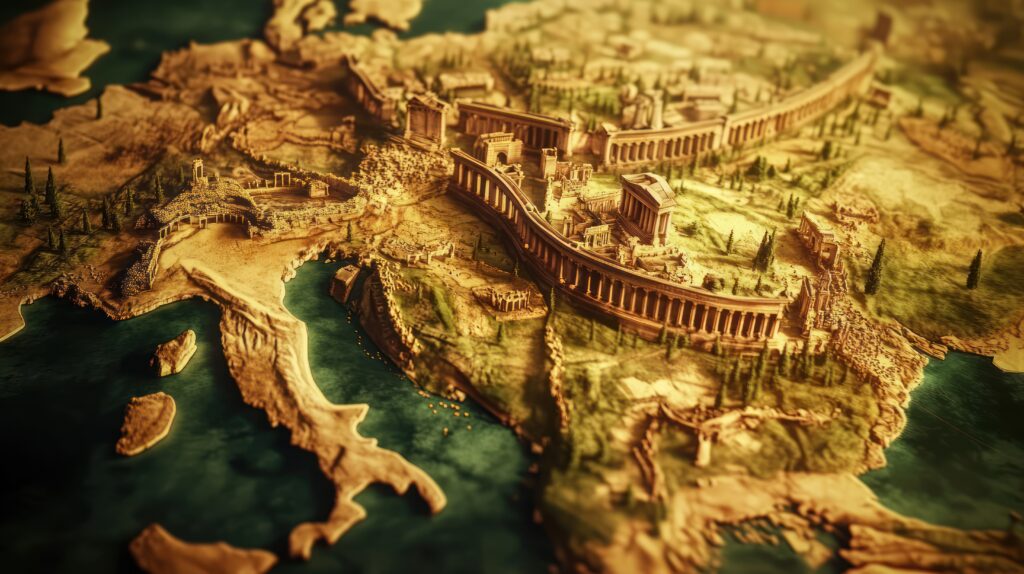
When asking ourselves how we should understand ‘Europe’, we can start with the term’s common understandings. It can refer to a geographical or cultural area, a religious or philosophical concept, or a historical process. None of these are wrong; they simply outline the variety of ways in which the concept of Europe has been referred to over time, in different regions and by different groups of people.
Origins in ancient Greece
Returning to the origins of the concept of ‘Europe’, one arrives or starts at the Greek term Εὐρώπη which is a compound of εὐρύς (eurýs = wide) and ὄψ (óps = face, view). One might argue that it implies both some form of plurality and unity: There is one (united) face that can be viewed, or one view that looks. However, it is not narrow or sharply defined, but rather a broad, open concept that allows for plural references to and from Europe.
Historical Approach
Initially used only for the geographical area of the Peloponnese, it gradually expanded to cover the entire ancient Greek world, and later the area stretching from Portugal to the Ural and Caucasus mountains. Later important periods that shaped our understanding of Europe in terms other than geography include the 17th-century state-building process, the collision with the Ottoman Empire, when Europe was equated with Christianity, and colonialism, which emerged from certain European countries and drew a line between them and the colonized rest of the world. Each of these notions of Europe differs slightly from the others, so it cannot be seen as one and therefore prevent a clear-cut definition. What people defined as Europe changed over time. Residuals of these different definitions combine or coexist simultaneously (even contradictorily) in historically virulent ideas/terms such as ‘Europe’. In this perspective, past, present and future are deeply intertwined.
Karl Jaspers as a philosopher of history
Karl Jaspers, a philosopher who attempted to systematically address the relations between time periods, wrote Die geistige Situation der Zeit (The Spiritual Situation of the Time) in 1932. This work focuses on the antecedents of contemporary events that led to the current state of affairs. Therefore, the past is inextricably linked to the present, and consequently to the future. This is particularly pertinent in the context of Europe, where the concept of unity in plurality is central. This concept includes a variety of perspectives on Europe from different groups of people throughout history until today, including those outside Europe in geographical terms.
Importance for today
Why is the European self-conception of identity important for our today’s understanding of Europe? As shown above, the term Europe has always and does continuously contain multitudes. Related to the question of a European community of remembrance, reflecting on its terminology opens up the field for plurivocal practices, views and positions united under the reference to the notion of Europe in its multiple and contested sense.
How Can Duties to Remember Be Justified?
What Should Be Remembered?
“We should focus on our own suffering, not others’. It’s not our story.”
“Talking so much about European history leaves no room to remember other atrocities.”
OR:
“Memory culture is not a battle for limited resources or room to remember. ”
“Other people’s stories can help us make sense of our own.”

Does a multidirectional approach to memory help or hurt victims?
The visibility of the memory of Holocaust victims is demonstrated by the Stolpersteine. The dominant role of the Holocaust in remembrance culture is sometimes criticised for excluding other historic events. As it shows one of the pitfalls of memory culture: competitive memory, which Michael Rothberg identifies as “the fact that today the Holocaust is frequently set against global histories of racism, slavery, and colonialism in an ugly contest of comparative victimization.” In such a culture of competitive memory, different parties compete for the recognition in collective memory.
Rothberg presents the alternative approach of multidirectional memory. The already established centrality and frameworks of Holocaust memory have the capacity to incorporate a plurality of victimhoods. Collective memory is not a contest where different events compete for space, but instead allows for a better understanding of an event such as the Armenian Genocide or the Yugoslav Wars. When there is a strong memory culture,underrepresented victims are better equipped to be remembered.
“The shared terrain of multidirectional memory creates possibilities for unexpected forms of solidarity, but it offers no guarantees.”as Michael Rothberg states in Multidirectional Memory. Remembering the Holocaust in the Age of Decolonization.
Could this be the future of European memory?
Memory & Sustainability
Should We Remember Nature?
Landscapes of Memory
Memory Mosaic

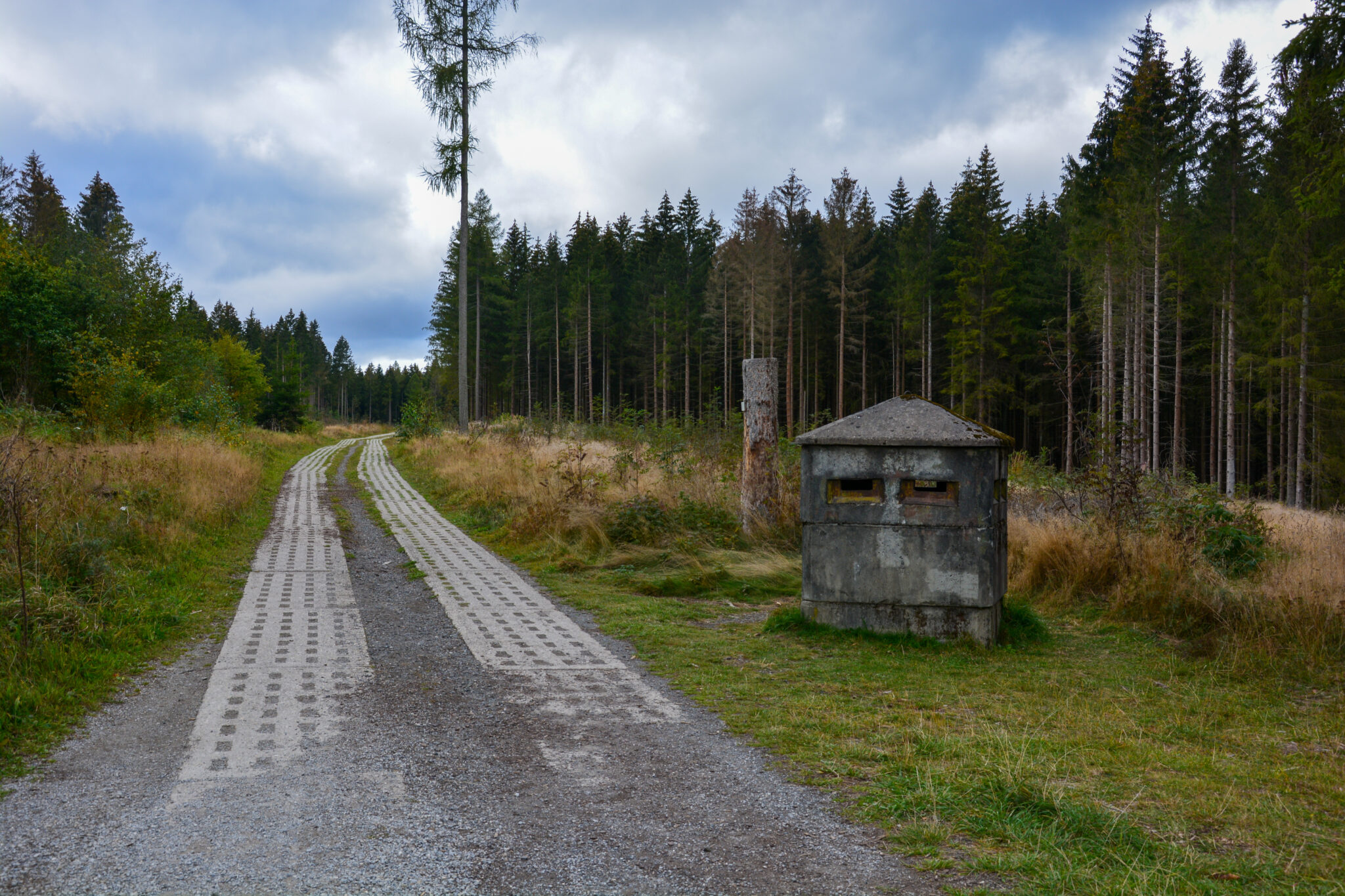

This podcast discusses the duty to remember nature. It focuses on the question of whether we can remember all species adequately. You will hear four different perspectives on the topic.
Interview with Prof. Dr. Sonja Pieck
Memories can be chaotic, maybe even overwhelming, they can pop out of nowhere, but they can also soothe us, create a sense of connection and identity. Like flowing water, our memories flow in their own way, making us who we are. Memory mosaic shows the complexity and intertwining of memories using short audio recordings from places dear to our hearts that we would like to be remembered. Those places are either in nature somewhere in the world or they are public places like busy streets, markets, cafeterias.
Texts Mentioned and Further Reading
ALTANIAN, Melanie (2021): Genocide Denial as Testimonial Opression. In: Social Etymology 35(2), 133 – 146.
BLUSTEIN, Jeffrey (2017): A Duty to Remember. In: Sven Bernecker / Kourken Michaelian (Ed.): The Routledge Handbook of Philosophy of Memory. Routledge: London [u.a.], 351 – 363.
DESSINGUÉ, Alexandre (2017): The Ethics of Memory in My Heart of Darkness. In: Jager, Benedikt and Hobuß, Steffi (Ed.): (Post)Colonial Histories – Trauma, Memory and Reconciliation in the Context of the Angolan Civil War, Bielefeld: transcript, 2017, 81-98.
DE TERWANGNE, Cécile (2014): The Right to Be Forgotten and Informational Autonomy in the Digital Environment. In: Alessia Ghezzi et al. (Ed.): The Ethics of Memory in a Digital Age. Interrogating the Right to Be Forgotten. Palgrave Macmillan London: Basingstoke, 82 – 101.
HEESEN, Jessica et al. (2024): Digital Afterlife and the Future of Collective Memory. In: Memory Studies Review 1. Brill Nijhoff, 274 – 291.
IVACS, Gabriella (2016): Digital Trauma Archives. The Yellow Star House Project. In: Anna Lisa Tota / Trever Hagen (Ed.): Routledge International Handbook of Memory Studies. Routledge: New York, 205 – 217.
ROTHBERG, Michael (2009): Multidirectional Memory. Remembering the Holocaust in the Age of Decolonization. Stanford University Press: Stanford.
MICHAELIAN, Kourken; SUTTON, John: Memory. In: The Stanford Encyclopedia of Philosophy (Summer 2017 Edition), Edward N. Zalta (ed.), URL = <https://plato.stanford.edu/archives/sum2017/entries/memory/>.
MARGALIT, Avishai (2002): The Ethics of Memory. Harvard University Press: Harvard.
MIHAI, Mihaela / THALER, Mathias (2024): Environmental Commemoration. Guiding Principles and Real-World Cases. In: Memory Studies 17(6), 1378 – 1395.
PESCHKE, Lutz (2015): The Web Never Forgets: Aspects of the Right to Be Forgotten. In: Gazi University Journal of Law Faculty, Vol. XIX, Issue 1.
PIECK, Sonja K. (2023): Mnemonic Ecologies. Memory and Nature Conservation Along the Former Iron Curtain. MIT Press: Cambridge, Massachusetts.
JASPERS, Karl (2010): Man in the Modern Age. Routledge: London.
authors
Aayma Saleem, Ana Felice Marchlewski, Anna May, Antonia Weis, Barbara Schober, Charlotte Boreham, Christoph Schranz, Clara Stuchtey, Emilia Hartl, Enrico Floris, Georg Ebster, Johanna Palm, Jule Köster, Katarina Tič, Lara Felföldi, Levente Gyenes, Maja Kraft, Maria Donica, Matej Vodopivec, Michael Pollex, Mira Groh, Nela Hedtke, Petr Franc, Po-Yen Hsu, Sara Očko, Shan-Chuan Hsiao, Stanislava Baranová, Valeria Gayoso, Vanessa Nistelberger, Wei-Chung Chen, Yannick Luca Sommer, Zorana Ećimović, Zorka Gabriella Fónyad, Züleyha Koltuk